The short answer
Tiffin School in Kingston sets its own 11+, in two stages, and in recent years every place has gone to a boy living within 10 km of the school. Stage One is English and maths on a computer-marked answer sheet. About a third of boys go on to sit a written Stage Two, and the final score is half English, half maths.
The test changes every year, but the way to prepare for it doesn’t.
Two papers, English and maths, sat at the school on one day in early October, in a morning or an afternoon slot. The test is written just for Tiffin, and according to the school’s admissions FAQs it changes every year: “Every year, completely new papers are written.” The number of questions, the timings and the question types all move.
The English paper is multiple choice. The maths paper mixes multiple choice with questions where your son works out a number and marks it on the answer sheet. A computer marks both. The school assumes boys have covered the Year 5 National Curriculum, no more, and warns that some questions come in unfamiliar formats.
The school publishes illustrative questions for both papers and an example of the maths answer sheet on its admissions page. Look at them with your son before he starts practising. They show the style far better than any description.
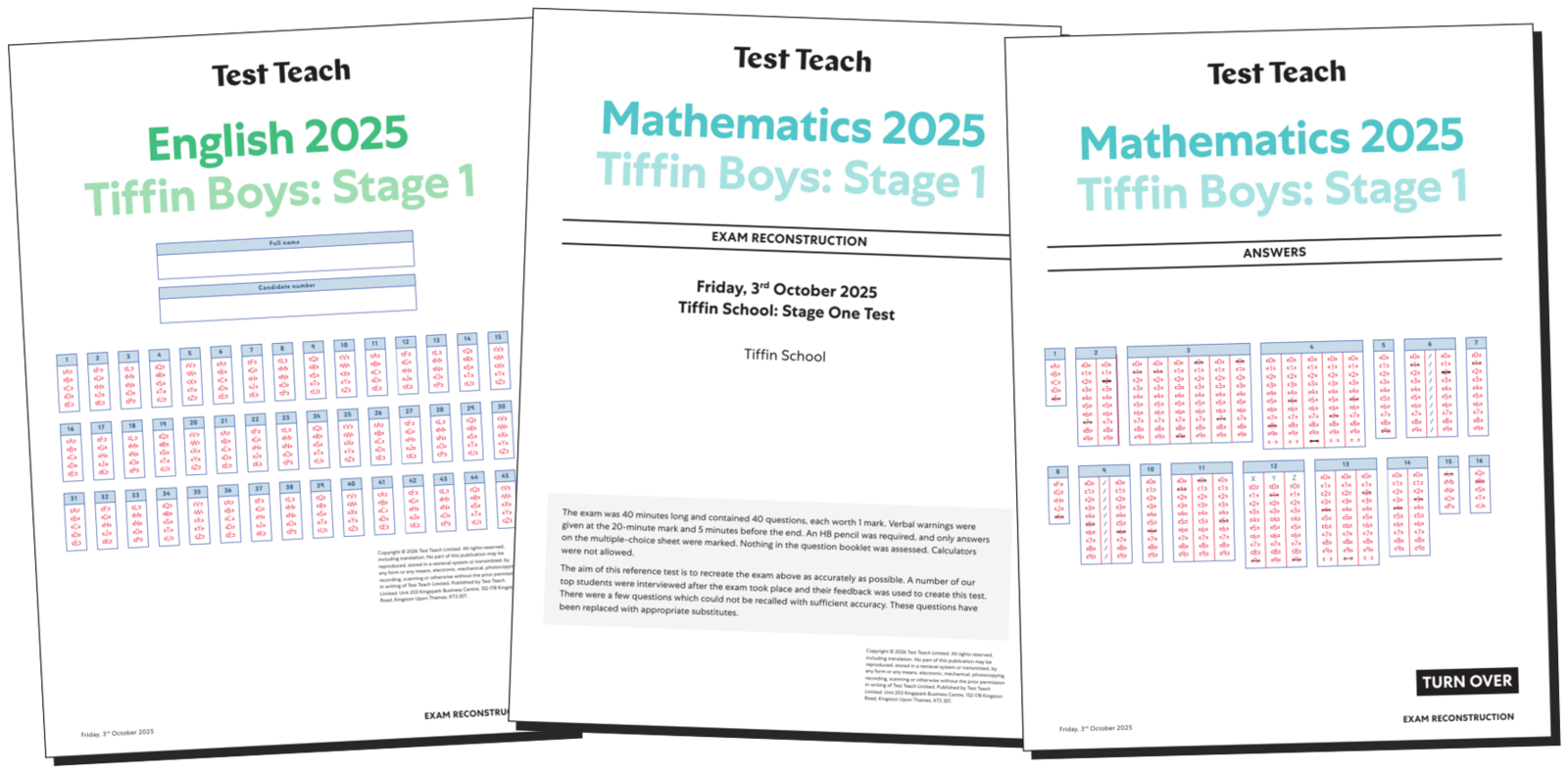
Here’s how the two papers looked in October 2025, from what our students told us the day after:
| English | Maths | |
|---|---|---|
| Questions | 45 | 40 |
| Time | 50 minutes | 40 minutes, no calculator |
| Sections | Spelling, punctuation and grammar: 16 questions First passage: Second passage: Comparing the two passages: |
One paper, no sections |
| Reading | The two passages came in their own booklet | |
| Marks | 1 mark each, apart from the five comparison questions at 2 marks | 1 mark each |
| Answers | Five options for every question. Most asked for one answer, and four asked for two, or for all that apply | Most answers built digit by digit, some multiple choice |
| Time warnings | Halfway, and 5 minutes before the end, on both papers | |
It isn’t the bubble sheet most practice books use. Each maths question has its own block on the sheet. For a multiple choice question, your son marks the box next to the letter. For a number, the block has a column for each digit, 0 to 9 down the side, and he marks one box in each column, like a lottery ticket. Some blocks have a decimal point, a colon for a time, or the units printed beside the digits. Units are in the question, so he never writes them.
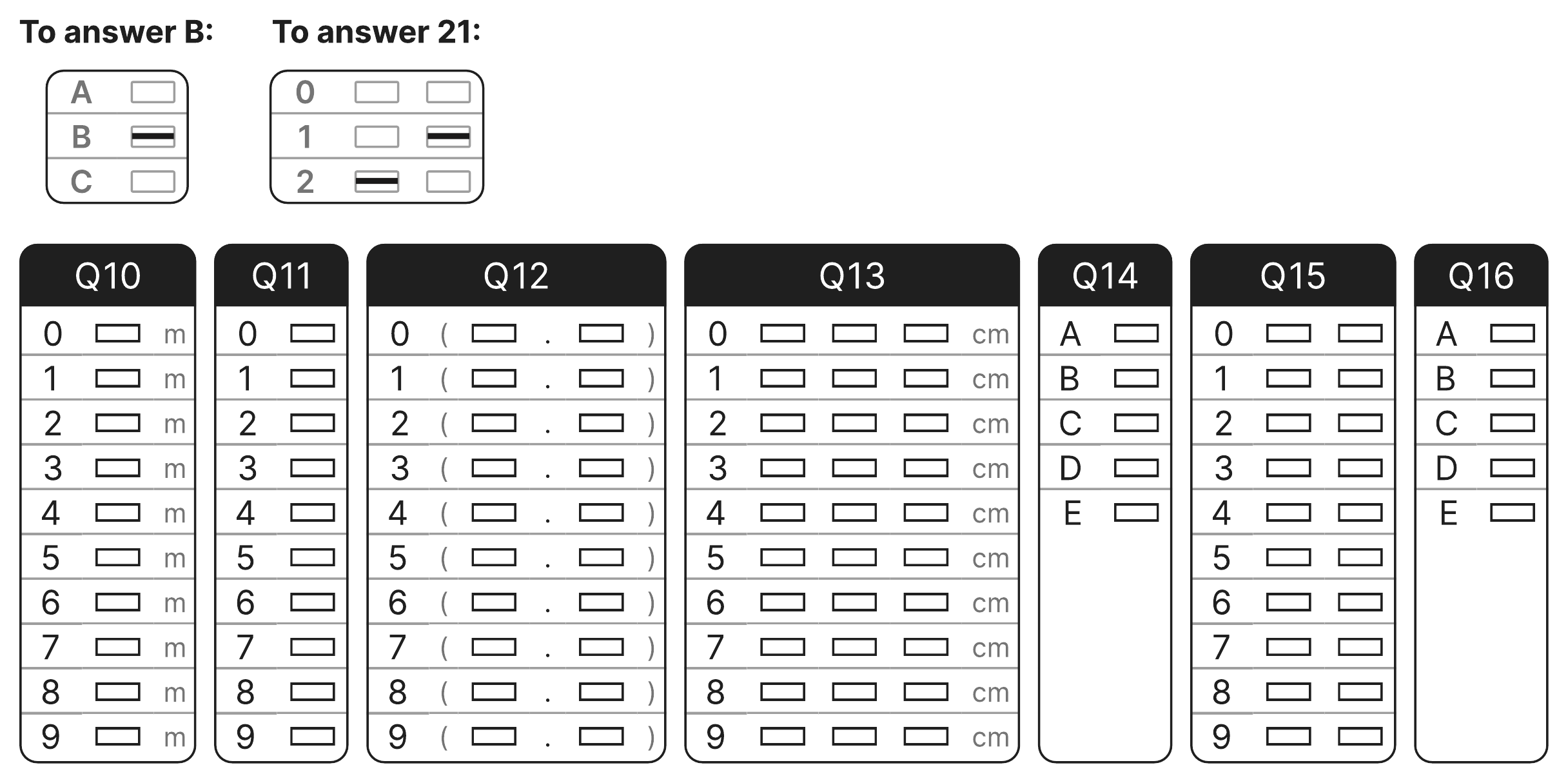
There’s nothing to guess from. A digit in the wrong column is a wrong answer, even when the maths was right. A boy who has only practised multiple choice can lose marks on that sheet without knowing why, so print the school’s example sheet and practise on it until filling it in is automatic.
We ask the boys who’ve just sat it. The school doesn’t release its papers, so the day after Stage One we ring our families and go through each paper with their sons, question by question, then rebuild it. Children remember the questions well but rarely every option, so the options in the examples below are ours.
Here’s a maths question from the 2025 paper, recalled with the same numbers on several calls:
Tiffin School 2025 · Maths
A grandpa has 3 grandchildren. Right now, the 3 children’s ages add up to 25 years. Five years ago, the combined age of the grandpa and his 3 grandchildren was 77 years. What is grandpa’s age right now?
Answer with a number.
72. Five years ago the children were 15 years younger in total (5 each), so they added up to 10. That leaves 77 − 10 = 67 for grandpa then, and 67 + 5 = 72 now. The trap is forgetting that all three children were younger too.
From our 2025 Tiffin School reconstruction.
And an English one from the same year:
Tiffin School 2025 · English
What word means the opposite of begin?
Z, terminate. To terminate is to end something, the opposite of beginning it. “Destroy” and “eliminate” are about getting rid of something, not ending it.
From our 2025 Tiffin School reconstruction.
This was the last question on the 2025 maths paper. One of our students drew it from memory the morning after, and that sketch is where our version of the question started.
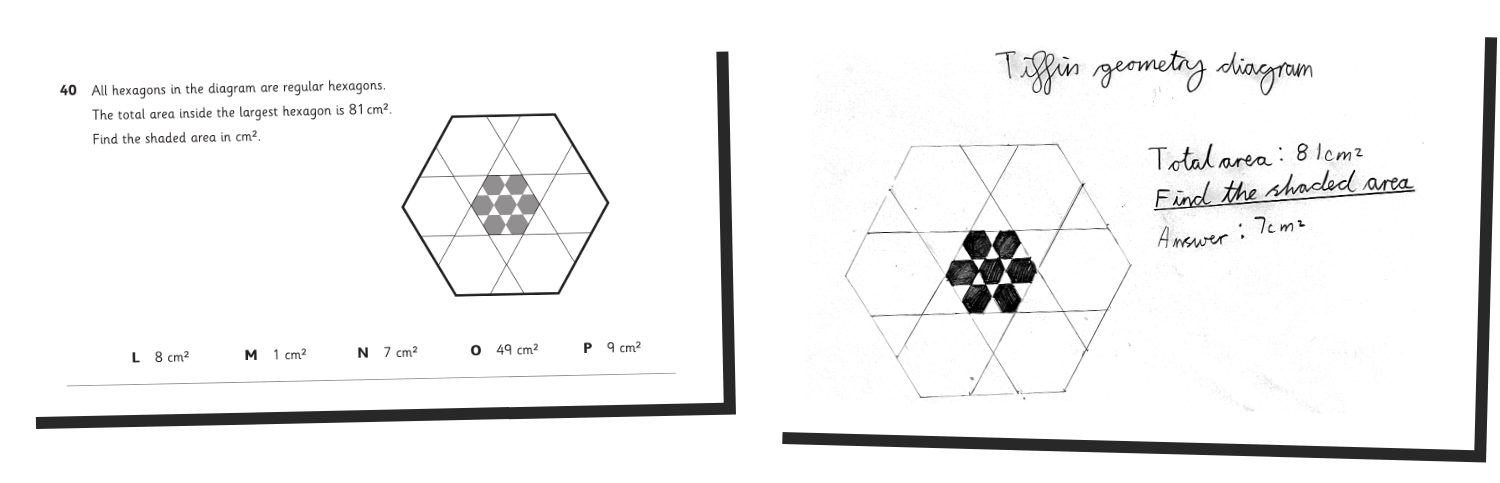
We asked students which part of their preparation they valued most. One said the practice papers “showed you what the Tiffin school papers were like, and I didn’t think that they’d be laid out like that. I thought it’d be like the Sutton ones.”
Stage One decides who sits Stage Two. After that, places go by a combined score, set out in the school’s admissions policy:
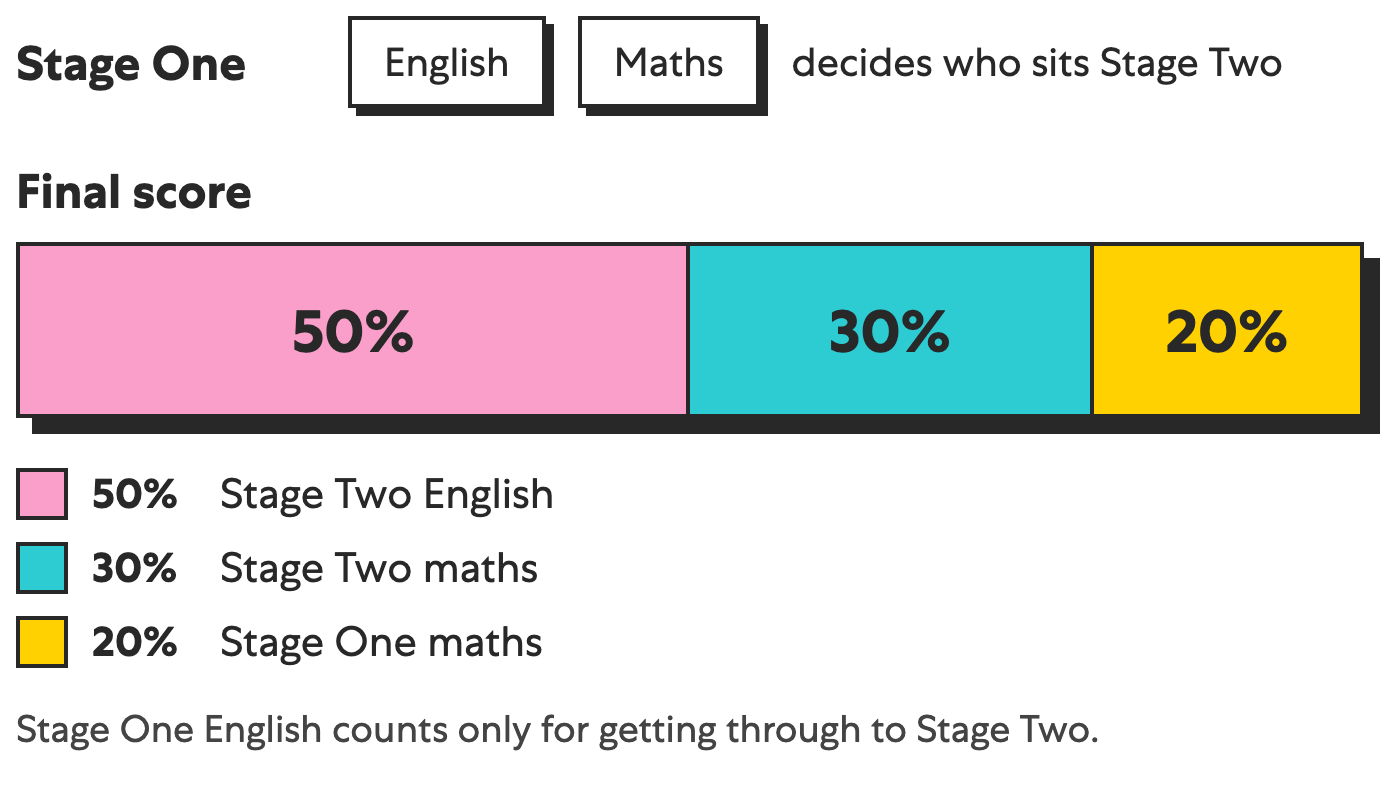
So the Stage Two English paper is half the result on its own, and the Stage One English paper stops counting once your son is through. All scores are standardised and adjusted for age.
Some boys get a 10% leeway at Stage One: looked after and previously looked after children, and boys whose primary school receives pupil premium funding for them, if they live in the Priority Area. Pupil premium boys can also get free practice material through the school, and its admissions page explains how.
Stage Two is written. English and maths are sat on the same day in mid November, the papers are similar in length to Stage One, and English and maths specialists mark them. Some English questions need longer written answers.
In 2025, our students told us English came first: five minutes to look through the booklet without writing, then an hour for three sections, 50 marks in all, with a suggested 25 minutes for comprehension, 25 for writing and 10 for the last task. Maths was 42 questions in 50 minutes, one mark each, with the answers written on a separate sheet that had the units printed and no marks for working.
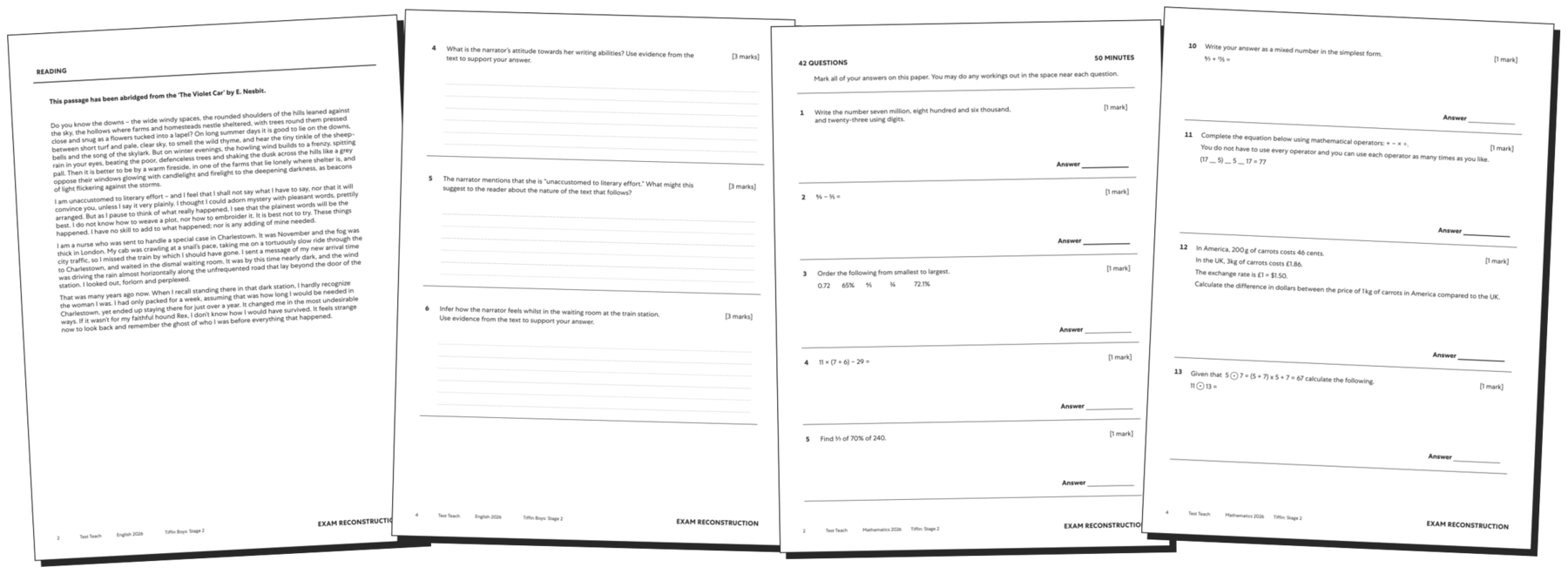
Some maths questions built on the one before, like this pair:
Tiffin School 2025 · Stage Two maths
Given that 5 ⊙ 7 = (5 + 7) × 5 + 7 = 67, calculate 11 ⊙ 13. Then, following on: what number does the black triangle ▲ represent, if 7 ⊙ ▲ = 329?
Write each answer on the answer sheet.
277, then 35. 11 ⊙ 13 = (11 + 13) × 11 + 13 = 264 + 13 = 277. For the second, (7 + ▲) × 7 + ▲ = 49 + 8 × ▲ = 329, so 8 × ▲ = 280 and ▲ = 35.
From our 2025 Tiffin School Stage Two reconstruction.
Between about 1,650 and 1,900 a year. For places starting in September 2026, 1,866 boys sat Stage One in October 2025, 665 sat Stage Two, and 186 places were offered on national offer day in March 2026, according to the school’s admissions figures. That’s roughly one in three through to Stage Two, and one place for every ten boys who sit Stage One. The lowest score that won a place on that offer day was 100.
Yes. Tiffin School has a Priority Area: every home less than 10 km from the school, measured in a straight line to its Queen Elizabeth Road gate. Boys who live inside it are offered places first, and its admissions policy is plain about what that means in practice:
Since September 2019, when a 10 km Priority Area was introduced, places have only been offered to those who live within 10 km of Tiffin School.
Tiffin School admissions policy, entry in 2027
Check the distance before you register. Kingston’s own measurement is the one that counts, so treat online distance tools as a rough guide.
Up to 18 places, about 10%, are kept for boys with an aptitude for sport (up to 9) or music (up to 9), according to the school’s admissions policy. They’re for boys who sit both stages and finish in the top 450 combined scores but don’t win a place on their score alone, and they have to live in the Priority Area too.
Registration for these assessments closes in early July, about two months before the main deadline, and the assessments themselves are held in July. The dates for each year are on the school’s admissions page.
The exact days move a little each year, but the shape stays the same.
Stage Two happens after the 31 October deadline, and you won’t see the Stage Two result before offer day. So if your son is invited to Stage Two, put Tiffin School on your common application form before he sits it. If he isn’t invited, a Tiffin School choice on the form can’t be used, but your other choices aren’t affected.
Start with school work. The tests assume the Year 5 National Curriculum and no more, so gaps in the basics cost more than missing tricks. The school’s own advice is worth reading twice: boys who are curious, read widely and enjoy puzzles and problem solving tend to enjoy its tests, and “some practice of working independently for an hour at a time may be helpful”. Then:
Then go back over mistakes. Testing shows the problem. Teaching the topic again and testing it again is what fixes it.
The Test Teach Kingston centre runs on Saturdays at Grey Court School in Ham. Each session is two hours, Maths then English, with a specialist teacher for each subject and a student mentor in the room. Every fourth Saturday, children sit a full Maths and English test under exam conditions, and you see the results the following week.
Test Teach papers are built around the Tiffin School tests, reconstructed from what boys tell us after the exam, and they come with digit-column answer sheets, so marking a number one digit at a time isn’t new on the day. They’re also deliberately harder than the real exam. That only helps if somebody explains it, so Test Teach does: a lower score with us usually means a stronger score on the day, and finding weak areas early is the point.
The materials are difficult and there can be a steep learning curve. But this is exactly what’s needed to pass the rigorous real exams, which get harder every year.
Mainur Rahman, on Trustpilot
Test Teach has prepared children in Kingston and Sutton for the 11+ since 2008. If your son is also sitting the Sutton SET, read What is the Sutton SET and which schools use it?
The ones parents usually ask straight after this one.