The short answer
The Sutton Selective Eligibility Test (SET) is one shared test, sat in mid September of Year 6. Six schools use it: five grammar schools and Greenshaw High School. It's two multiple choice papers, Maths and English. Passing makes your child eligible for the next stage, not for a place.
Know which hurdle you’re preparing for, and the SET gets a lot less mysterious.
Six schools take part in the SET, according to Sutton Grammar School’s SET FAQs. Five of them are the selective grammar schools in the London Borough of Sutton, three for boys and two for girls.
For boys:
For girls:
The sixth is Greenshaw High School, which takes boys and girls. Greenshaw isn’t a grammar school. It uses the SET to decide which children can be considered for its 60 ability places, and children who don’t pass can still get a place there under its other criteria.
You fill in one online registration form and it covers all six schools. It also counts as the supplementary form for every school in the group, so there’s nothing extra to send.
Two papers: one Maths, one English. Both are multiple choice. There’s no verbal reasoning and no non-verbal reasoning.
Each paper takes between 40 and 50 minutes, with a break in between. Children mark their answers on a separate sheet by filling in a bubble for A, B, C, D or E.
Here’s how the two papers looked in September 2026, from what our students told us the day after:
| English | Maths | |
|---|---|---|
| Questions | 31 | 50 |
| Time | 45 minutes | 50 minutes |
| Sections | Four, each timed: spelling (5 questions, 5 minutes), the first passage (10 questions, 15 minutes), the second passage (10 questions, 15 minutes), then comparing the two (6 questions, 10 minutes) | One paper, no sections |
| Answers | Bubbles A to E. Questions said “Select ONE”, “Select TWO” or “Select ALL” | Bubbles A to E |
| Time warnings | Halfway, and 5 minutes before the end, on both papers | |
Here’s a maths question from the 2025 paper. Like every example in this article, it’s rebuilt from what the children who sat it told us. They remember the questions well but rarely all five options, so the A to E options are ours.
Sutton SET 2025 · Maths
This is a magic square. Each row, column and diagonal must add up to the same total, called the magic number. Find the value of x.
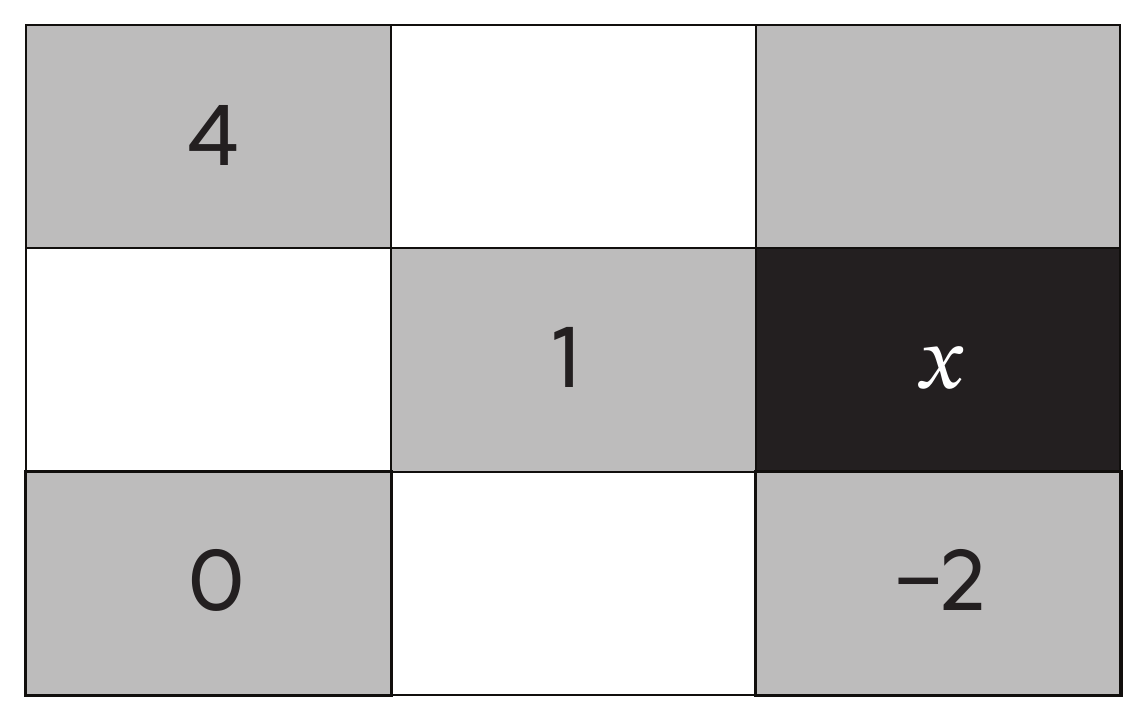
A, 3. The diagonal 4 + 1 + (−2) = 3, so the magic number is 3. The left column needs 4 + ? + 0 = 3, so the middle-left square is −1. Then the middle row is −1 + 1 + x = 3, so x = 3.
From our 2025 reconstruction.
Some questions need a combination of answers. A changed answer has to be rubbed out properly.
A few details to know before the day:
Here’s what “select two” looked like on the 2025 English paper. The second passage was from The Kite Runner, and this question was about its last line:
Sutton SET 2025 · English
What two things does the last line, “And may God, if He exists, that is, strike me blind if the kite didn’t just drop into his outstretched arms,” tell you?
Select two correct answers.
D and E. Amir isn’t doubting God or worrying about his eyesight. It’s his way of saying he could hardly believe it: he’s astonished by the catch, and he exaggerates to show it. Pick both, because one right answer on its own scores nothing.
From our 2025 reconstruction.
Having no past papers is why so much SET practice is guesswork. A paper can look like an 11+ paper and still not look like the SET.
We ask the children who’ve just sat it. The schools don’t release the papers, so the day after the SET we ring our families and go through the exam with their children, question by question.
English starts with the passages. The paper doesn’t say which book a passage came from, so we ask who was in it, where it was set and what happened, until we can work out the book, and then the exact pages. Maths comes back the same way, one question at a time, sometimes with a sketch of a diagram a child still remembers.
Take this one from September 2026. One of the first children we spoke to remembered “palindromic numbers, three digits”. Later calls filled in the wording and corrected the details, until we had the question:
Sutton SET 2026 · Maths
A palindrome is a number that reads the same forwards and backwards, such as 131. How many three-digit palindromes are there between 100 and 1000?
C, 90. The first digit can be 1 to 9 and the middle digit 0 to 9, and the last digit has to match the first. That makes 9 × 10 = 90.
From our notes on the 2026 paper. The full reconstruction isn’t finished yet.
The children remember far more than the questions. In 2025 the first English passage was printed on green paper and the second on pink, with a separate bubble sheet that runs A to E across the page rather than down it. When our students came out of the SET in September 2026, the green and pink sheets were back.
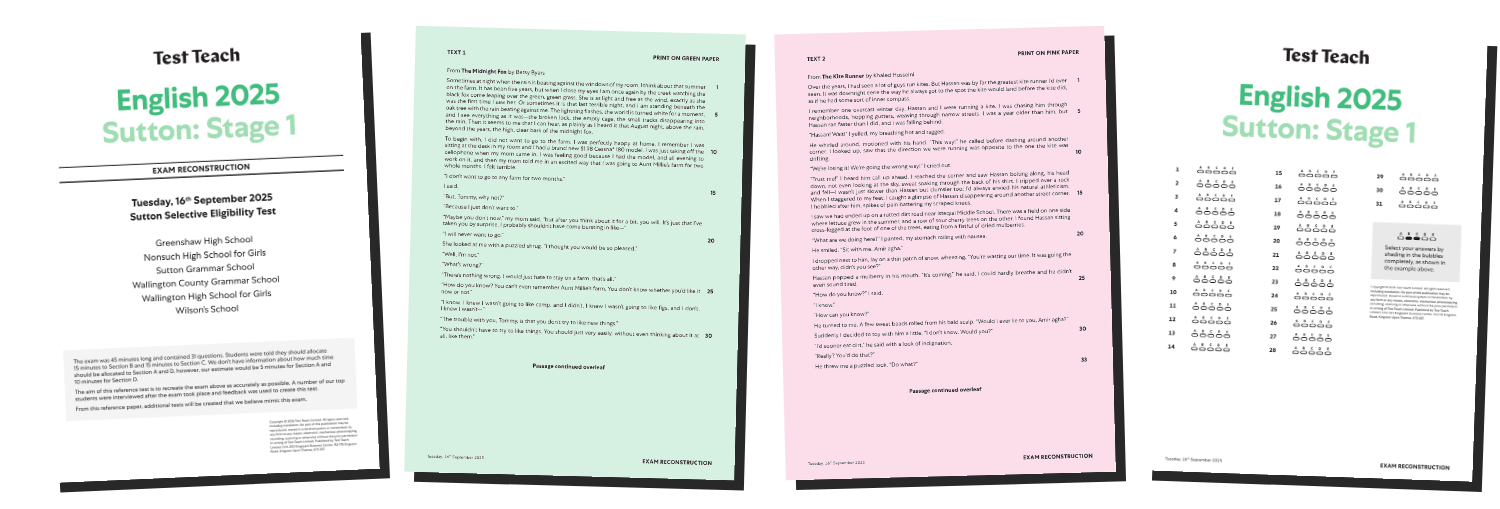
Then we rebuild the paper, with its inserts and its answer sheet, and our students sit it under the real timings. It’s a reconstruction, not the paper itself, and we say so. But it’s the closest a child can get to the SET before the day, and it means the coloured sheets and the bubble sheet aren’t new when they turn the first page.
We asked students who had sat the 11+ how close our papers were to the real thing. “So, so similar,” said one. “And the answer sheets as well.”
You’ll get an email with the outcome during the week after the test.
There’s no fixed pass mark. The schools set it after the papers are marked, and each school can set its own. Scores are standardised and adjusted for age, and it’s the total that counts. So a very good English paper can make up for a slightly weaker Maths one.
Passing the SET means your child is invited to a second stage test at the grammar schools.
The second stage splits by school:
The second stage is a Maths paper and an English paper. Unlike the SET, it isn’t multiple choice. Children write their answers.
Here’s what our students told us about the 2026 second stages:
The SET score still counts, because it’s combined with the second stage score. Second stage outcomes arrive by email before the end of October.
A lot. Around 6,600 children sat the Sutton SET in September 2025, according to figures the schools released under Freedom of Information, and roughly a third of them cleared the first stage.
On the other side are around 900 places across the five grammar schools. Sutton Grammar School’s admissions policy sets 150 places in Year 7, and Sutton Council lists 150 at Wallington County Grammar School, 186 at Wilson’s School and 210 each at Nonsuch and Wallington High School for Girls.
Competition is real, and it helps to know that early. It’s also why passing the SET is a starting point. The schools say plainly that passing the tests doesn’t guarantee the offer of a place.
The exact days move a little each year, but the shape stays the same.
No. This is the part families most often find out late.
Registering for the test. You do this online in the summer of Year 5. Registration usually opens at the start of May and closes at the end of July. The schools don’t accept late registrations under any circumstances.
Applying for a school place. You name your chosen schools on your council’s common application form by 31 October in Year 6. Sitting the SET doesn’t apply for anything.
Two more rules surprise many families. Your child can only sit the SET once, in Year 6. A younger child can’t sit it in Year 5 as practice. And the schools ask families to register only if they’re genuinely interested in a place, not to use the SET as a free mock for other schools.
Prepare for the test your child will actually sit.
Practise Maths and English, not reasoning. Time spent on verbal or non-verbal reasoning is time the SET won’t reward.
Practise on paper with a separate answer sheet. Filling in bubbles for A to E against the clock is a skill of its own. A child who has only practised on a screen meets it for the first time on the day. That’s why every paper Test Teach rebuilds after an exam comes with that exam’s own style of answer sheet.
Practise writing answers too. The second stage isn’t multiple choice. A child who has only ever picked from five options can struggle when they have to show their working.
Sit whole papers under real timings. Running out of time is one of the most common problems, and it’s a technique problem rather than a knowledge one. We’ve written more about this in How do we start practising for 11+ papers? For a mock in a real exam room, see our guide to 11+ mock exam providers.
Test Teach has prepared children in Sutton and Kingston for the 11+ since 2008. Test Teach papers are built around the SET, reconstructed from what children tell us after the exam. In the Saturday classes at Sutton and Kingston, qualified secondary school teachers teach two hours each week, half Maths and half English, and children sit a full test under exam conditions every month.
The free Test Teach SET maths reconstruction is a good place to start: one full paper under real conditions shows you where your child is now.
A full 50 question maths paper built around the September Sutton SET, free. One timed sitting shows you where your child is now. Straight to your inbox, no card needed.
"*" indicates required fields
It is so important that children practice exam conditions regularly in order to improve their exam technique and speed.
MCPoppy, on Trustpilot
The ones parents usually ask straight after this one.