The short answer
Good revision materials do three things: they match the exam your child will actually sit, they run to real timings, and they explain every wrong answer rather than just marking it. Most of what's on sale does the first badly and the last one not at all.
If you change one thing, stop choosing by brand and start choosing by what your child’s schools actually set.
Before you buy anything, find out which paper your child will sit. It is the single decision that makes everything else easier, and it is the one most families skip.
There is no such thing as “the 11+”. GL Assessment writes the papers for a large share of grammar school admissions in England, Kent, Buckinghamshire, Birmingham and Redbridge among them. CEM withdrew from 11+ papers after the 2022 round, and the areas that used it moved to GL, to a newer provider called Quest, or wrote their own.
Plenty of schools go their own way. Sutton’s grammar schools share the Selective Eligibility Test, the SET, sat in mid September. Get through it and your child is invited to a second stage. The boys’ schools, Sutton Grammar, Wilson’s and Wallington County, share one written paper, and the girls’ schools, Nonsuch and Wallington Girls, share another. Tiffin runs two rounds as well: a multiple choice paper first, then a written paper for the children who get through. A practice book from the shops looks like none of them.
Here is what “looks like” means. The SET English paper arrives as a kit: a question booklet, two passages printed on separate inserts, one green and one pink, and a multiple-choice sheet of ovals to fill in. Our students had the colours and the sheet again in September 2026. A child who has only ever worked through a book meets all of that for the first time in the hall.
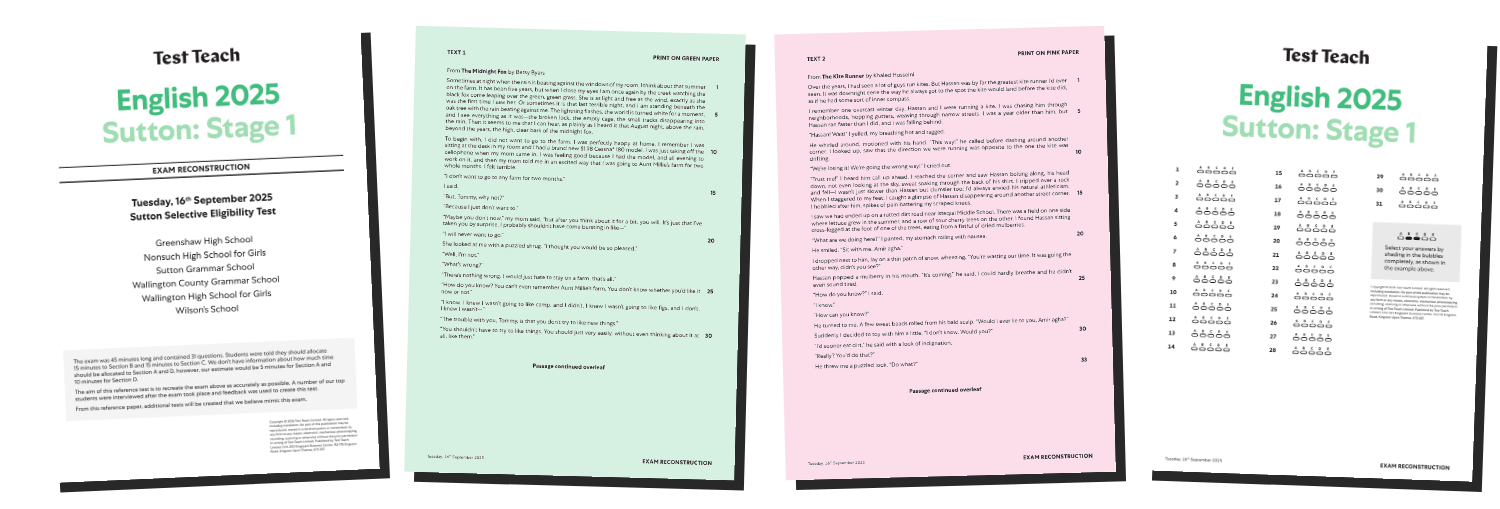
That detail comes from the children. In the week after each exam we ring our students who sat it and go through the paper with them, question by question: the passages, the diagrams they can still sketch, the question that caught everyone out. Call after call, the paper comes back together, and we rebuild it with that exam’s own answer sheet. It’s a reconstruction, and we say so, but it’s the closest a child can get to the real paper before the day.
So the first job isn’t revision. It’s a list: which schools, which paper, which term. Every school publishes this on its own admissions pages, along with a rough idea of what the paper will look like. Very rough. Schools do change their exams, so check the year you’re preparing for rather than trusting a forum post. Some years they change it with no notice at all.
The shared boys’ second stage in Sutton recently put a comprehension section in front of the writing task. Nobody was told beforehand.
That gap between the outline and the paper is why we rebuild each exam from the children who sat it.
One thing families discover late: sitting the test and applying for a school place are separate jobs. You name your choices on your council’s common application form by 31 October.
The report at the end, not the questions at the front. Anyone can write questions. What your child needs is to find out why an answer was wrong while there’s still time to act on it. Look for three things.
The materials provided to students are excellent – there are videos covering an explanation on all the topics both in English and Maths as well as video explanation on each and every question that the children are faced with.
WJ, on Trustpilot
A full 50 question maths paper built around the September Sutton SET, free. One timed sitting shows you where the marks went. Straight to your inbox, no card needed.
"*" indicates required fields
Both, and they do different jobs. This is the mistake we see most often: families buy a stack of practice papers and expect them to teach.
A workbook teaches a topic. A paper tests whether it stuck, which is why the Test Teach course pairs weekly teaching with a monthly timed paper. Testing alone shows the gap without closing it, and a child who sits paper after paper with nobody explaining the misses gets faster at being wrong.
The pattern that works is dull but reliable. Sit a full paper under timing, go through every miss with an explanation, then do it again the next week.
Bond, CGP and the GL practice books are perfectly good at the teaching end, and most families in our classes own some. They’re written for the national picture rather than for your schools, so use them for topics and get your paper practice from something built closer to home.
Yes, as long as somebody explains that it is. Test Teach papers are deliberately harder than the real thing, and we say so to every family before they see a score.
The reason is simple. A child who is comfortable at a level above the exam walks into the hall with room to spare. A child who has only ever scored 90% on gentle material has never had to work out what to do when a question resists.
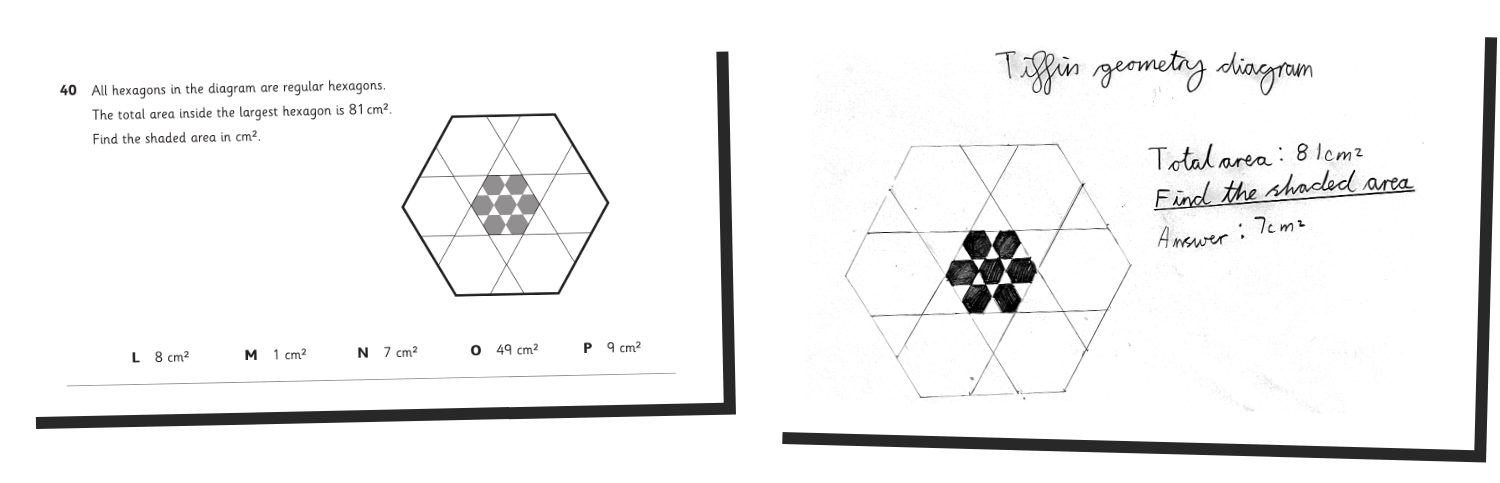
It helps to know what “the real thing” looks like. This was the last question on the 2025 Tiffin Boys maths paper, as our students remembered it the day after: all the hexagons are regular, the big one has an area of 81 cm², find the shaded area. The answer is 7 cm², because the shaded part is seven small hexagons and the big one holds 81 of them. No measuring, no formula, just the nerve to count. A child who has met questions like it before knows to look for the pattern. A child who hasn’t starts measuring and loses the minute.
The materials are difficult and there can be a steep learning curve. But this is exactly what’s needed to pass the rigorous real exams, which get harder every year.
Mainur Rahman, on Trustpilot
You need two numbers over time: what your child scored, and where that sits among children preparing for the same exams. A raw mark means nothing alone. Sixty two per cent is excellent on a hard paper and worrying on an easy one, and no parent can tell which they’re holding.
That’s why we rank them. Test Teach has run monthly mocks under exam conditions in the Saturday classes for years. The teaching team marks them, then the whole year group goes on one sheet: more than a hundred children, highest score to lowest, each child as a number, every question marked right, wrong or left blank. Yours is the only number you know, so you can see exactly where your child stands without anyone being named.
It’s honest, and some months it stings. We don’t soften it, because a child who is near the bottom in the autumn needs you to know while there’s still time to do something about it. A kinder report that hides the ranking takes away the one thing you came for.
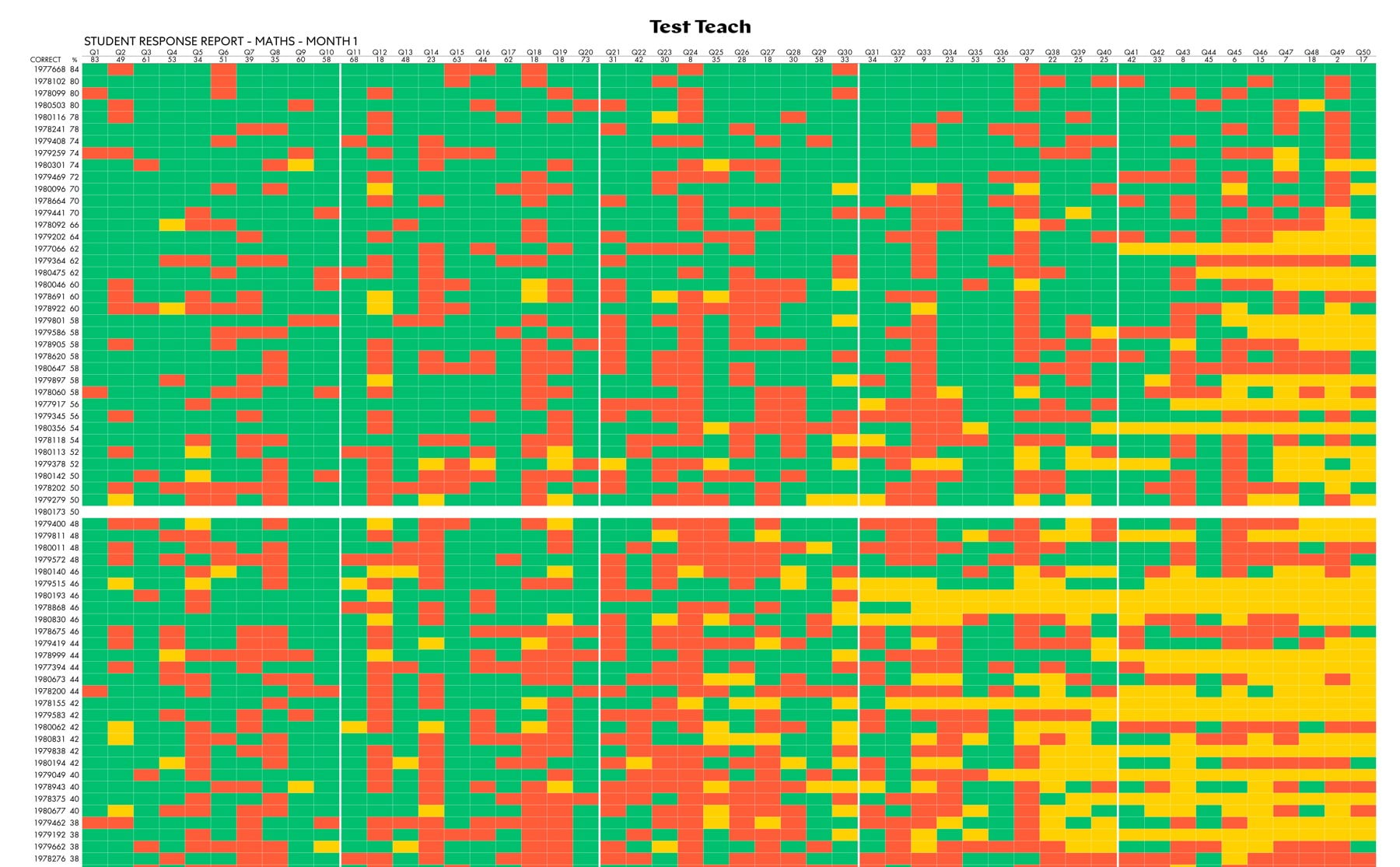
Whatever you use, the questions to ask a provider are the same. Do you show where the marks went, and can I see how my child compares with a group of a decent size?
Some mock providers never return the test your child sat, so you get a score with no way of seeing what it was a score in.
Private one to one tutors typically charge between £40 and £80 an hour, and London and the grammar heavy counties sit at the top of that range. That is the number most families measure everything else against.
Materials sit far below that. The Test Teach online course is £15 a week for printed Maths and English papers, posted by Royal Mail on Monday mornings, with video explanations and the learning platform. The Saturday classes at Sutton and Kingston are £55 a week for two hours, half Maths and half English, first lesson free.
It’s worth doing the arithmetic on the alternative. Local independent day schools now run to roughly £25,000 to £31,000 a year including VAT. A grammar place delivers a comparable education for nothing, which is why the queue is long: around 6,600 children sat the Sutton SET in September 2025, according to figures the schools released under Freedom of Information, and roughly a third of them cleared the first stage. There are 163 grammar schools in England, each with a queue of its own.
None of that guarantees anything, and anyone who tells you otherwise is selling. What it buys is a fair go at a competitive exam.
The ones parents usually ask straight after this one.